 Deluan Quintão
3f7226d253
Deluan Quintão
3f7226d253
* fix(server): capture ffmpeg stderr and warn on empty transcoded output

When ffmpeg fails during transcoding (e.g., missing codec like libopus),
the error was silently discarded because stderr was sent to io.Discard
and the HTTP response returned 200 OK with a 0-byte body.

- Capture ffmpeg stderr in a bounded buffer (4KB) and include it in the
  error message when the process exits with a non-zero status code
- Log a warning when transcoded output is 0 bytes, guiding users to
  check codec support and enable Trace logging for details
- Remove log level guard so transcoding errors are always logged, not
  just at Debug level

Signed-off-by: Deluan <deluan@navidrome.org>

* fix(server): return proper error responses for empty transcoded output

Instead of returning HTTP 200 with 0-byte body when transcoding fails,
return a Subsonic error response (for stream/download/getTranscodeStream)
or HTTP 500 (for public shared streams). This gives clients a clear
signal that the request failed rather than a misleading empty success.

Signed-off-by: Deluan <deluan@navidrome.org>

* test(e2e): add tests for empty transcoded stream error responses

Add E2E tests verifying that stream and download endpoints return
Subsonic error responses when transcoding produces empty output.
Extend spyStreamer with SimulateEmptyStream and SimulateError fields
to support failure injection in tests.

Signed-off-by: Deluan <deluan@navidrome.org>

* refactor(server): extract stream serving logic into Stream.Serve method

Extract the duplicated non-seekable stream serving logic (header setup,
estimateContentLength, HEAD draining, io.Copy with error/empty detection)
from server/subsonic/stream.go and server/public/handle_streams.go into a
single Stream.Serve method on core/stream. Both callers now delegate to it,
eliminating ~30 lines of near-identical code.

* fix(server): return 200 with empty body for stream/download on empty transcoded output

Don't return a Subsonic error response when transcoding produces empty
output on stream/download endpoints — just log the error and return 200
with an empty body. The getTranscodeStream and public share endpoints
still return HTTP 500 for empty output. Stream.Serve now returns
(int64, error) so callers can check the byte count.

---------

Signed-off-by: Deluan <deluan@navidrome.org>

Navidrome Music Server 








Navidrome is an open source web-based music collection server and streamer. It gives you freedom to listen to your music collection from any browser or mobile device. It's like your personal Spotify!
Note: The master branch may be in an unstable or even broken state during development.
Please use releases instead of
the master branch in order to get a stable set of binaries.
Check out our Live Demo!
Any feedback is welcome! If you need/want a new feature, find a bug or think of any way to improve Navidrome, please file a GitHub issue or join the discussion in our Subreddit. If you want to contribute to the project in any other way (ui/backend dev, translations, themes), please join the chat in our Discord server.
Installation
See instructions on the project's website
Cloud Hosting
PikaPods has partnered with us to offer you an officially supported, cloud-hosted solution. A share of the revenue helps fund the development of Navidrome at no additional cost for you.

Features
- Handles very large music collections
- Streams virtually any audio format available
- Reads and uses all your beautifully curated metadata
- Great support for compilations (Various Artists albums) and box sets (multi-disc albums)
- Multi-user, each user has their own play counts, playlists, favourites, etc...
- Very low resource usage
- Multi-platform, runs on macOS, Linux and Windows. Docker images are also provided
- Ready to use binaries for all major platforms, including Raspberry Pi
- Automatically monitors your library for changes, importing new files and reloading new metadata
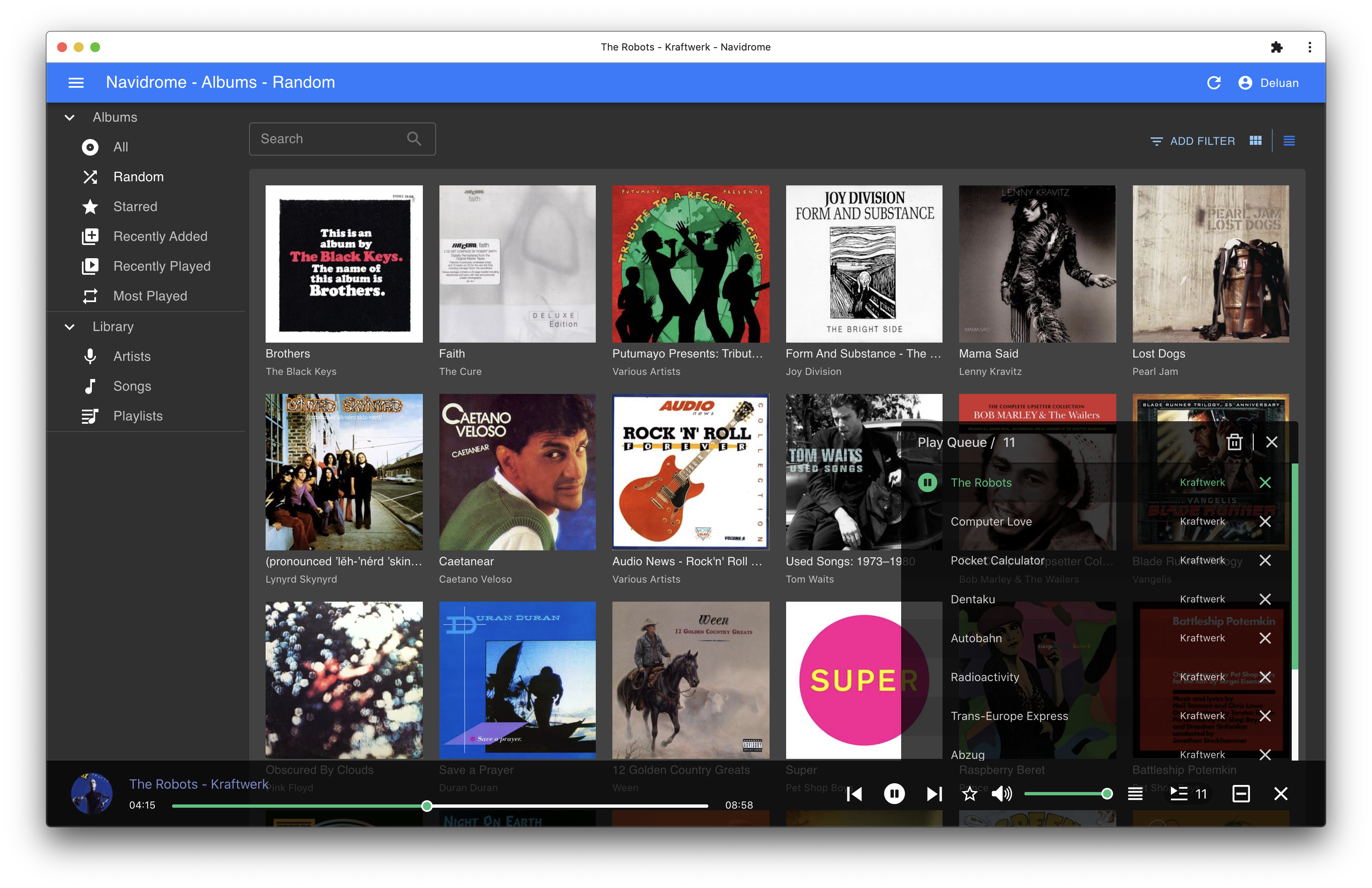
- Themeable, modern and responsive Web interface based on Material UI
- Compatible with all Subsonic/Madsonic/Airsonic clients
- Transcoding on the fly. Can be set per user/player. Opus encoding is supported
- Translated to various languages
Translations
Navidrome uses POEditor for translations, and we are always looking for more contributors
Documentation
All documentation can be found in the project's website: https://www.navidrome.org/docs. Here are some useful direct links:
Screenshots