 Deluan Quintão
7ad2907719
Deluan Quintão
7ad2907719
* refactor: move playlist business logic from repositories to core.Playlists service

Move authorization, permission checks, and orchestration logic from
playlist repositories to the core.Playlists service, following the
existing pattern used by core.Share and core.Library.

Changes:
- Expand core.Playlists interface with read, mutation, track management,
  and REST adapter methods
- Add playlistRepositoryWrapper for REST Save/Update/Delete with
  permission checks (follows Share/Library pattern)
- Simplify persistence/playlist_repository.go: remove isWritable(),
  auth checks from Delete()/Put()/updatePlaylist()
- Simplify persistence/playlist_track_repository.go: remove
  isTracksEditable() and permission checks from Add/Delete/Reorder
- Update Subsonic API handlers to route through service
- Update Native API handlers to accept core.Playlists instead of
  model.DataStore

* test: add coverage for playlist service methods and REST wrapper

Add 30 new tests covering the service methods added during the playlist
refactoring:

- Delete: owner, admin, denied, not found
- Create: new playlist, replace tracks, admin bypass, denied, not found
- AddTracks: owner, admin, denied, smart playlist, not found
- RemoveTracks: owner, smart playlist denied, non-owner denied
- ReorderTrack: owner, smart playlist denied
- NewRepository wrapper: Save (owner assignment, ID clearing),
  Update (owner, admin, denied, ownership change, not found),
  Delete (delegation with permission checks)

Expand mockedPlaylistRepo with Get, Delete, Tracks, GetWithTracks, and
rest.Persistable methods. Add mockedPlaylistTrackRepo for track
operation verification.

* fix: add authorization check to playlist Update method

Added ownership verification to the Subsonic Update endpoint in the
playlist service layer. The authorization check was present in the old
repository code but was not carried over during the refactoring to the
service layer, allowing any authenticated user to modify playlists they
don't own via the Subsonic API. Also added corresponding tests for the
Update method's permission logic.

* refactor: improve playlist permission checks and error handling, add e2e tests

Signed-off-by: Deluan <deluan@navidrome.org>

* refactor: rename core.Playlists to playlists package and update references

Signed-off-by: Deluan <deluan@navidrome.org>

* refactor: rename playlists_internal_test.go to parse_m3u_test.go and update tests; add new parse_nsp.go and rest_adapter.go files

Signed-off-by: Deluan <deluan@navidrome.org>

* fix: block track mutations on smart playlists in Create and Update

Create now rejects replacing tracks on smart playlists (pre-existing
gap). Update now uses checkTracksEditable instead of checkWritable
when track changes are requested, restoring the protection that was
removed from the repository layer during the refactoring. Metadata-only
updates on smart playlists remain allowed.

* test: add smart playlist protection tests to ensure readonly behavior and mutation restrictions

* refactor: optimize track removal and renumbering in playlists

Signed-off-by: Deluan <deluan@navidrome.org>

* refactor: implement track reordering in playlists with SQL updates

Signed-off-by: Deluan <deluan@navidrome.org>

* refactor: wrap track deletion and reordering in transactions for consistency

Signed-off-by: Deluan <deluan@navidrome.org>

* refactor: remove unused getTracks method from playlistTrackRepository

Signed-off-by: Deluan <deluan@navidrome.org>

* refactor: optimize playlist track renumbering with CTE-based UPDATE

Replace the DELETE + re-INSERT renumbering strategy with a two-step
UPDATE approach using a materialized CTE and ROW_NUMBER() window
function. The previous approach (SELECT all IDs, DELETE all tracks,
re-INSERT in chunks of 200) required 13 SQL operations for a 2000-track
playlist. The new approach uses just 2 UPDATEs: first negating all IDs
to clear the positive space, then assigning sequential positions via
UPDATE...FROM with a CTE. This avoids the UNIQUE constraint violations
that affected the original correlated subquery while reducing per-delete
request time from ~110ms to ~12ms on a 2000-track playlist.

Signed-off-by: Deluan <deluan@navidrome.org>

* refactor: rename New function to NewPlaylists for clarity

Signed-off-by: Deluan <deluan@navidrome.org>

* refactor: update mock playlist repository and tests for consistency

Signed-off-by: Deluan <deluan@navidrome.org>

---------

Signed-off-by: Deluan <deluan@navidrome.org>

Navidrome Music Server 








Navidrome is an open source web-based music collection server and streamer. It gives you freedom to listen to your music collection from any browser or mobile device. It's like your personal Spotify!
Note: The master branch may be in an unstable or even broken state during development.
Please use releases instead of
the master branch in order to get a stable set of binaries.
Check out our Live Demo!
Any feedback is welcome! If you need/want a new feature, find a bug or think of any way to improve Navidrome, please file a GitHub issue or join the discussion in our Subreddit. If you want to contribute to the project in any other way (ui/backend dev, translations, themes), please join the chat in our Discord server.
Installation
See instructions on the project's website
Cloud Hosting
PikaPods has partnered with us to offer you an officially supported, cloud-hosted solution. A share of the revenue helps fund the development of Navidrome at no additional cost for you.

Features
- Handles very large music collections
- Streams virtually any audio format available
- Reads and uses all your beautifully curated metadata
- Great support for compilations (Various Artists albums) and box sets (multi-disc albums)
- Multi-user, each user has their own play counts, playlists, favourites, etc...
- Very low resource usage
- Multi-platform, runs on macOS, Linux and Windows. Docker images are also provided
- Ready to use binaries for all major platforms, including Raspberry Pi
- Automatically monitors your library for changes, importing new files and reloading new metadata
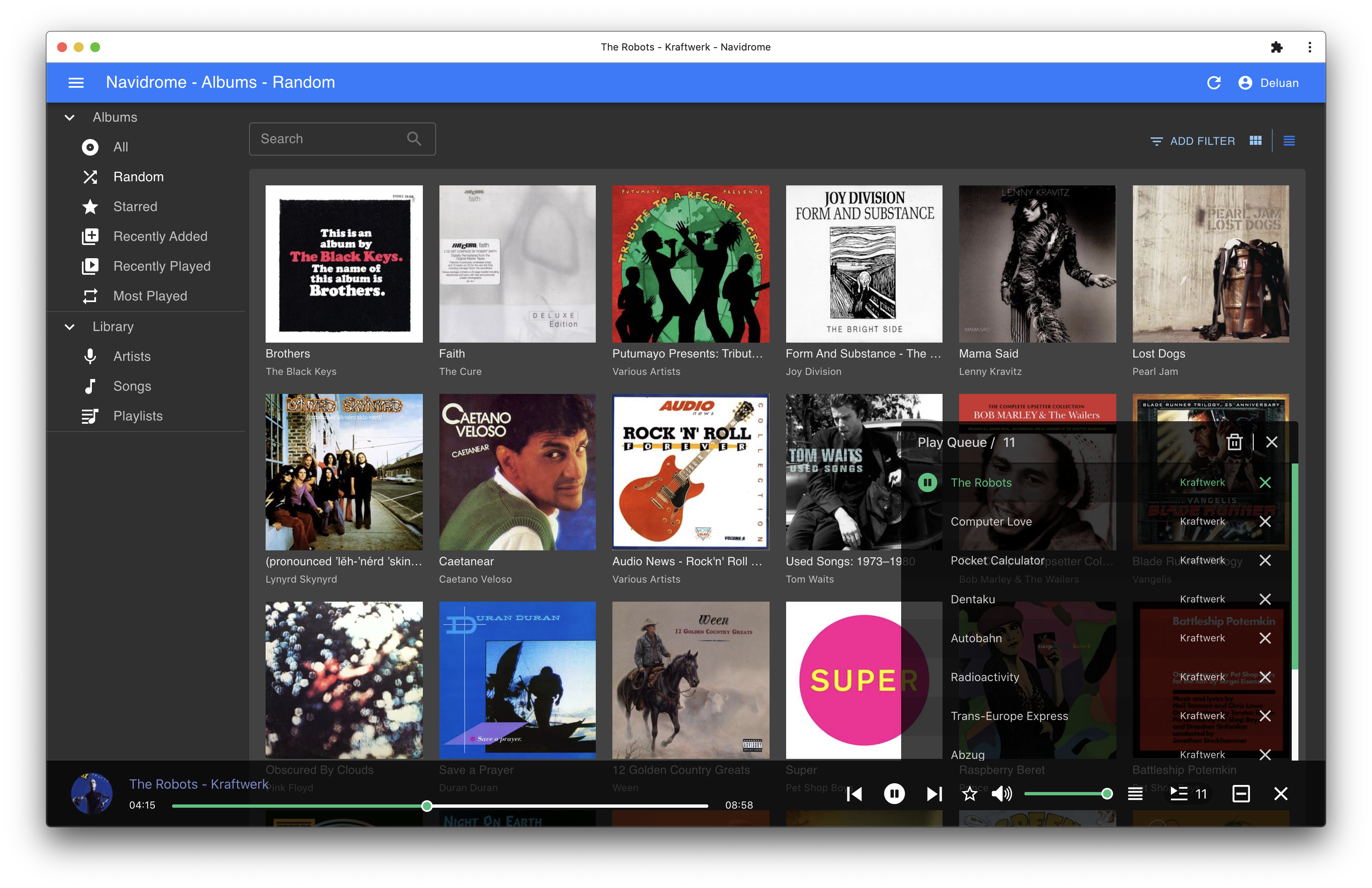
- Themeable, modern and responsive Web interface based on Material UI
- Compatible with all Subsonic/Madsonic/Airsonic clients
- Transcoding on the fly. Can be set per user/player. Opus encoding is supported
- Translated to various languages
Translations
Navidrome uses POEditor for translations, and we are always looking for more contributors
Documentation
All documentation can be found in the project's website: https://www.navidrome.org/docs. Here are some useful direct links:
Screenshots